
The Acoustic Echoes of Northern Deindustrialisation
Post-punk is often explained as an ideological break with punk, a turn towards art school experimentation, political critique and deliberately difficult textures. That account is useful, but incomplete. In northern England, the music also emerged from a physical world that seemed to speak in its own register: empty mills, blackened brick, concrete housing, elevated walkways, railway cuttings and venues where sound struck hard surfaces before returning in altered form. The geography was not merely a backdrop for rebellion. It helped determine the pressure, spacing and grain of the records.
By the late 1970s, Manchester, Leeds and Sheffield were living through industrial decline at visibly different speeds, yet each city carried the same sense of a modern promise wearing out. Victorian warehouses and textile buildings stood beside post-war estates and brutalist civic structures. Against that landscape, the rush of raw punk began to stretch, fracture and slow. Three-chord velocity gave way to bass-led patterns, clipped guitars, machine-like drums and vocal performances that sounded less like communal release than an announcement broadcast across an empty concourse. For listeners exploring the era on vinyl, the key is to hear these records as spatial documents, not simply as manifestos.
Brutalist Architecture and the Sonic Blueprint of Bleakness
Brutalism did not create northern post-punk, and musicians were rarely composing architectural diagrams in sound. Yet the movement”s concrete environments offered a powerful visual and acoustic vocabulary. Post-war housing schemes, pedestrian decks and monumental university buildings embodied functionalism at a scale that could feel both efficient and hostile. Their surfaces were hard, their corridors often exposed and their geometry resistant to the softening effects of domestic life. In cities under economic strain, such spaces could appear less like symbols of progress than unfinished machinery.
This mattered because sound behaves differently in dense, reflective environments than in intimate rooms. A stairwell, underpass or subterranean walkway can turn a single snare hit into a brief metallic flare. A bass note can seem to occupy the entire passage. Even when a band recorded in a conventional studio, musicians carried an awareness of these sonic conditions into arrangement and production. Reverb became less a decorative effect than a way of suggesting distance, disorientation and public space.
The relationship between architecture and rebellion has been traced across post-punk culture, from Factory Records” industrial visual language to the use of neglected modernist buildings as cultural sites. A useful overview of this connection appears in research on brutalism and post-punk, which places music within a wider psychogeography of concrete, dereliction and artistic reuse. The strongest records do not simply sound bleak. They organise bleakness, giving it angles, intervals and pressure points.
- Hard surfaces encouraged an interest in reflection, echo and sudden decay.
- Modular housing and civic geometry found an analogue in repeating riffs and tightly controlled structures.
- Urban distance helped produce vocals that sounded detached, confrontational or deliberately impersonal.
- Neglected infrastructure provided a visual and social setting for DIY performance and independent record-making.
Leeds Underground and the Clatter of Social Tensions
Leeds brought these spatial pressures into especially sharp focus. Its post-punk scene developed amid deindustrial decline, economic inequality, political conflict and the claustrophobic public atmosphere associated with the Yorkshire Ripper murders. That context should not be reduced to a single cause, but it helps explain why bands such as Gang of Four and Delta 5 made music that refused easy consolation. Their songs could be danceable, yet the dance was fractured. The groove invited movement while the guitar and vocal phrasing exposed the tension underneath it.
Gang of Four”s angularity was not simply a matter of unusual technique. The band rejected macho guitar display, using short, abrasive figures that behaved more like interruptions than traditional rock riffs. The bass frequently carried the central hook, while the drums supplied a dry, almost bodily insistence. Songs such as “Damaged Goods”, “Contract” and “Anthrax” dismantled familiar ideas about romance, consumption and performance. In that sense, the jagged guitar mirrored a jagged social reality: relationships appeared structured by power, commerce and surveillance rather than by the sentimental language of mainstream pop.
Academic research into Leeds post-punk culture, including this study of the Leeds scene and its sociopolitical climate, connects the city”s brutalist university architecture, industrial decline and gender politics to the music”s austere textures. The research is also important for challenging the idea that Leeds feminism was simply “unisex”. Women in the scene developed separatist and openly sceptical positions towards conventional male behaviour, giving the music a sharper understanding of who controlled space, attention and bodily safety.
The sound was also shaped by where people gathered. Unpolished venues and communal nights created conditions in which bands could test ideas without the smoothing effect of the professional music industry. The F-Club, remembered through interviews and later scene narratives, became more than a lost venue. It functions as a contested memory of belonging, status and resistance in a city whose alternative spaces were later transformed, privatised or displaced. The archival study of the F-Club shows why venue geography matters: scenes survive not only in recordings, but in stories about who was present, who felt excluded and which rooms acquired symbolic force.
The Factory Floor and Mechanical Cadence
Industrial sound entered northern post-punk less through literal sampling than through bodily memory. Textile mills, engineering plants and steelworks organised daily life around repetition, shifts and mechanical timing. Even when machinery had fallen silent, its logic remained embedded in the city. Drummers used patterns that suggested production lines without imitating them directly. Bassists found that a repeated figure could be both melodic and functional, a moving part that kept the song operating while the guitar supplied sparks and abrasion.
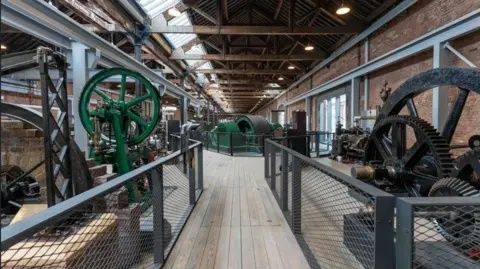
This was one reason the bass guitar became such a decisive instrument. In conventional rock, bass often reinforces the guitar”s harmonic frame. In post-punk, it could become the track”s main architectural support, outlining space while carrying the memorable phrase. Joy Division”s stark propulsion, Gang of Four”s elastic funk and the Fall”s repetitive verbal-musical mechanisms all demonstrate different responses to the same broad condition: rhythm could express alienation more effectively than grand emotional release. The groove did not escape the factory. It converted the factory”s discipline into something unstable.
| Industrial condition | Musical translation |
|---|---|
| Repetitive machinery and shift rhythms | Looped drum figures, strict tempos and insistently repeated bass lines |
| Empty mills and abandoned works | Open sonic space, sparse arrangements and reverb that suggests absence |
| Metal, brick and concrete surfaces | Dry percussion, clipped guitar attacks and harsh upper frequencies |
| Economic decline and disrupted community life | Detached vocals, fractured structures and refusal of conventional resolution |
Manchester”s late-1970s conditions made this translation particularly visible. Factory closures, unemployment, strikes, demolition and deteriorating neighbourhoods formed the social atmosphere around bands associated with Joy Division, the Fall and the developing Factory Records network. Factory”s cooperative identity helped turn local infrastructure into cultural infrastructure, linking records, design, venues and a sense of collective authorship. The label”s importance was not that it erased industrial decline, but that it gave the city”s fractured energies a durable form.
Studies and archival accounts of lost punk and post-punk spaces show how venue geography preserved the industrial atmosphere in communal memory. Those spaces were often temporary, rough-edged and acoustically imperfect, but that imperfection was productive. A small room with inadequate sound reinforcement could force a band to emphasise rhythm, attack and physical presence. The result was music that felt engineered for bodies in a room, even when later heard through headphones or a carefully pressed record.
Sheffield Tape Loops and the Foundries of Electronic Austerity
Sheffield followed a distinct electronic route through the same broad crisis. Where Manchester”s most famous post-punk records often turned guitar bands into engines of atmosphere, Sheffield groups such as Cabaret Voltaire and The Human League explored primitive synthesisers, tape manipulation and metal-like percussion. The city”s steel identity made technology feel immediate rather than futuristic. Electronics did not represent a clean escape from industry. They sounded like its afterimage, stripped of warmth and rebuilt as circuits, pulses and found noise.
Cabaret Voltaire”s work is especially revealing because it treats the studio as a site of industrial assembly. Tape loops, processed voices and repetitive fragments make the listener aware of editing as a physical act. A phrase can be cut, duplicated and repositioned until language becomes material. The Human League”s early work approached repetition differently, using sparse electronic structures that exposed the gap between a human voice and an impersonal machine. Across both approaches, austerity came from limitation: primitive equipment produced deliberate narrowness, while limited resources encouraged invention.
Sheffield”s artistic responses were also site-specific. Former steelworks, warehouses, nightclubs and other industrial locations became settings for exhibitions, screenings and performances that treated the city as both subject and medium. Later programmes such as Art Sheffield 2016 revisited this relationship through sound, moving image and commissions placed across urban and industrial sites. The work demonstrated how a city”s technological history could be activated rather than nostalgically preserved, turning closure and repurposing into material for new cultural experiments.
- Tape loops transformed repetition into a physical sense of entrapment.
- Primitive synthesisers produced unstable tones that sounded colder and stranger than polished pop electronics.
- Metal percussion and processed noise connected the studio to Sheffield”s industrial materiality.
- Detached vocal performances placed human vulnerability against mechanical continuity.
- Repurposed sites made performance part of the city”s continuing argument with its industrial past.
The contrast between voice and machine is central to Sheffield”s emotional power. A singer can sound exposed, uncertain or painfully ordinary while the backing track continues with indifferent precision. That tension avoids the obvious theatricality of despair. Instead, alienation becomes a structural fact, built into the relationship between a living performer and a repeating electronic pattern. It is a sound that still travels well, particularly for contemporary artists working with drum machines, cheap synthesisers and deliberately degraded recording techniques.
Listening to the Cityscape Beyond the Record Grooves
Northern post-punk remains compelling because its austerity was never merely a fashion. It was an acoustic imprint of industrial decline, urban design and contested communal space. Concrete, brick, steel and empty infrastructure shaped the imagination of musicians who were already questioning rock”s inherited gestures. Their records turned absence into arrangement, repetition into pressure and local geography into a form of musical memory.
For modern listeners, the most rewarding approach is to follow the movement from place to sound rather than treating Manchester, Leeds and Sheffield as interchangeable points on a genre map. The following route offers a practical way into that geography:
- Begin in Manchester with Joy Division and the early Factory Records orbit, listening for open space, severe dynamics and rhythm that seems to advance through fog.
- Move to Leeds through Gang of Four and Delta 5, focusing on clipped guitars, bass-led hooks, confrontational vocals and the politics embedded in the groove.
- Enter Sheffield”s electronic underground with Cabaret Voltaire and early The Human League, paying attention to tape, repetition, metal percussion and the unstable border between person and machine.
- Return to the venues by reading scene histories and archival work, because the lost club, rehearsal room and improvised stage are essential parts of how these records sounded.
- Follow the legacy into contemporary alternative music, where DIY electronics, post-industrial visuals and angular rhythm continue to make cities audible.
The lasting lesson is not that every northern post-punk song sounds like a factory or a housing estate. It is that the best music found formal equivalents for lived conditions. Its spaces remain audible in the gaps between instruments, its machinery survives in the bass lines and its social tensions still flash through the guitar. Listen closely enough, and the record becomes more than a document of a scene. It becomes a map of a city learning how to speak after the machines have stopped.